

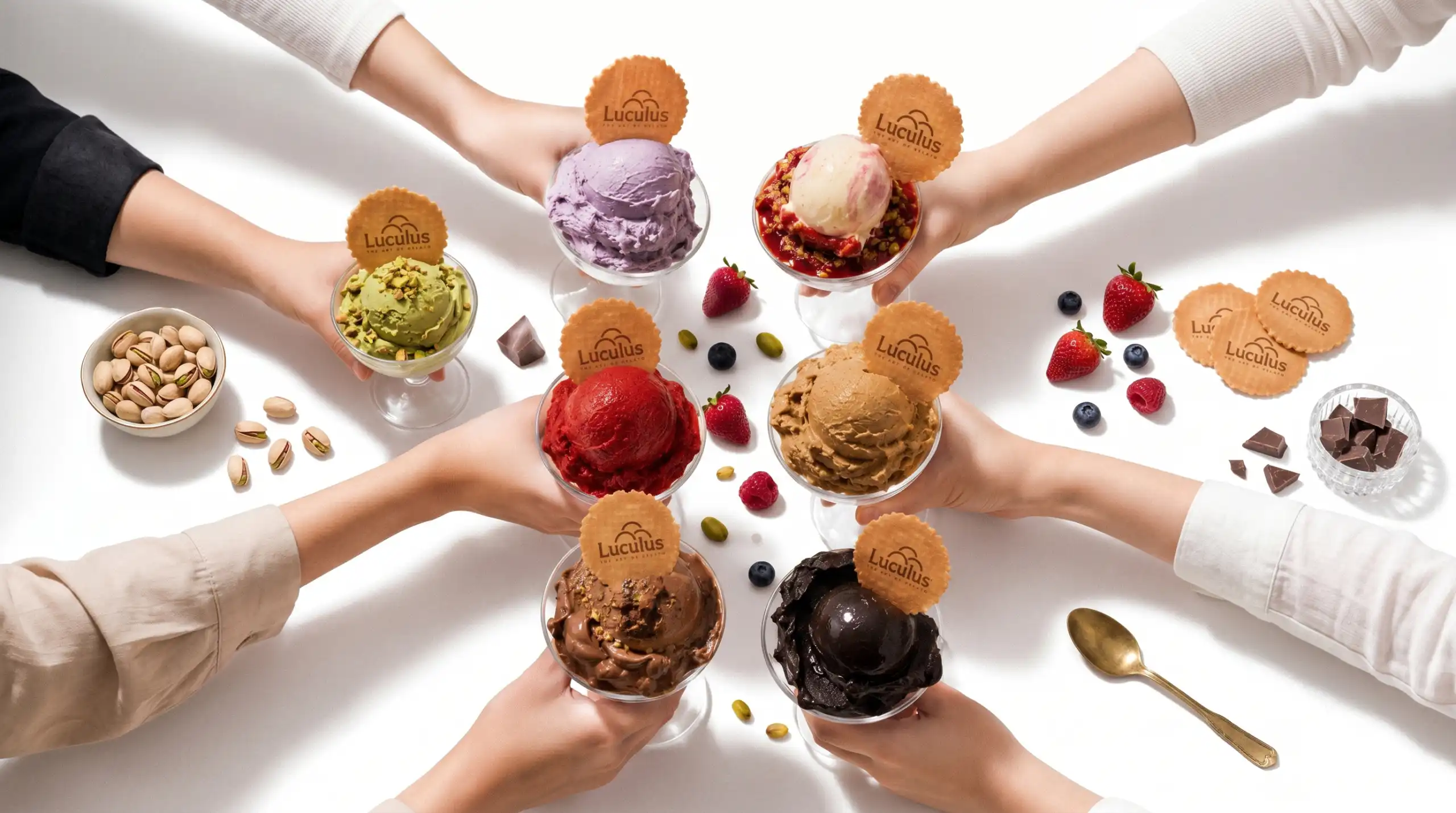
In 1954 the shop at Hviezdoslavovo námestie 25 sold sweets to children. It was not a gelateria and nobody planned for it to become one. That happened slowly, the way most things in a family business happen: someone tried something, it worked, and then it was simply how things were done.
Seventy-two years later there are four Luculus shops in Bratislava and the recipes still come from the same place. This is what has changed in that time, and what has not.
A candy store first
Post-war Bratislava was not a city with much of a dessert culture to speak of. A shop selling sweets on the main square was doing something modest and local, and for a while that was the whole business.
Ice cream came into it the way it came into a lot of central European confectioneries: as a summer line that turned out to be more popular than the thing it was supposed to supplement. The seasonal rhythm that shaped those early years is still visible in how the four shops run today. Cold desserts carry the summer, and from autumn the counter shifts toward pastries, coffee and hot chocolate. The building empties and refills with the weather.

What gets passed down, and what does not
People assume a heritage recipe is a piece of paper in a drawer. It is more often a set of tolerances: how thick the base should look on the back of a spoon, how long to wait, what to do when the fruit is not as good as it should be.
The parts that have not changed in seventy years are the boring parts. More milk than cream, which keeps the fat content low and lets the flavour through. Slow churning, which keeps the air out and gives gelato its density. Small batches, because gelato has a short useful life and a big batch is only an efficiency if you are willing to sell it stale.
The parts that have changed are almost everything else. Freezers hold temperature to a degree now instead of a range. Fruit arrives from further away and in better condition. Allergen labelling is a legal requirement rather than a courtesy. And an entire category of dairy-free recipes exists that nobody in 1954 would have had any reason to develop.
None of that touches the method. It just means the method is easier to execute consistently.
The 150-scoop cone
In 2011 one of our confectioners, Nadži, built a single cone carrying 150 scoops of ice cream and set a Slovak record doing it.
It is not a serious contribution to the craft. It is a stunt, and everyone involved knew it was a stunt. But it is the kind of thing that happens in a shop where the same people have worked for a long time and are comfortable enough to try something ridiculous on a slow afternoon. Fifteen years later people still bring it up at the counter.
Why the flavours keep moving
An archive of recipes built over seven decades is only useful if you actually go back into it.
Fruit is seasonal, so anything built on fruit appears and disappears. Some recipes are permanent because their absence would be noticed immediately, and pistachio and nougat are the obvious examples. The rest rotate, which means the case looks meaningfully different depending on when you walk in.
This is also where the odd ones come from. A gelato built on a Slovak pastry, or on a dessert from somewhere else entirely, usually starts as an experiment during a quiet week. Most do not survive. A few become the thing people ask for by name a year later.
If you want to know what is in the case today, the honest answer is that it depends on the day, and the person behind the counter will tell you.
What seventy years does not guarantee
A long history is not a quality argument on its own. Plenty of old businesses coast on the date above the door.
What it does give you is a very long feedback loop. A recipe that has been made every summer for decades has been corrected by thousands of small complaints and second orders. That is not romance, it is just data collected slowly. It is also why we are cautious about changing things that work and unbothered about changing things that do not.
The other thing it gives you is a fixed address. Four of them, in fact, in a city small enough that people come back with their children and expect to recognise something. That expectation is a useful constraint. It makes it very difficult to quietly cut a corner.
Where to find us
The original shop was at Hviezdoslavovo námestie 25. We are now at numbers 16 and 24 on the same square, on Panská 29, and at Račianske mýto 5.
If you want the technical side of what separates gelato from ice cream, we wrote about that here, and there is a separate piece on dairy-free gelato and sorbet. Otherwise, our current flavours are the better place to start, and our story has the longer version of the above.
Frequently asked questions
How old is Luculus?
The first shop opened on Hviezdoslavovo námestie in Bratislava in 1954, originally as a children’s candy store. It has been operating continuously since.
How many Luculus shops are there?
Four, all in Bratislava: Hviezdoslavovo námestie 16 and 24, Panská 29, and Račianske mýto 5.
What is the Slovak record for scoops on one cone?
150 scoops, set in 2011 by Nadži, a confectioner at Luculus.
Do the flavours change?
Yes. Fruit-based recipes follow the season and most of the range rotates through the year. A small number of flavours, including pistachio and nougat, are permanent.
Is Luculus open in winter?
No.
What was the shop before it sold ice cream?
A candy store. Ice cream began as a summer addition and gradually became the main business.