


Most people use “gelato” and “ice cream” as if they mean the same thing. They don’t. The difference is not marketing language, it is a difference in recipe, in machinery, and in the temperature at which the tub sits before it reaches you.
We have been making gelato in Bratislava since 1954, when the first Luculus opened on Hviezdoslavovo námestie as a children’s candy store. Four shops later, the questions we get across the counter have not changed much. What follows is how we answer them.
Gelato is not ice cream, and here is why
Three things separate the two. None of them is obvious from looking at a menu.
Less fat. Ice cream leans on cream and egg yolks. Gelato uses more milk than cream, which brings the fat content down considerably. Lower fat sounds like a loss, but fat coats the tongue and dulls what you taste. Take some of it away and the flavour arrives faster and cleaner. A pistachio gelato tastes more like pistachio than a pistachio ice cream does.
Less air. Industrial ice cream is churned fast, and fast churning whips air into the mix. Some products are close to half air by volume. Gelato is churned slowly, so far less air goes in. That is why a scoop of gelato feels heavier in the hand than a scoop of ice cream the same size. You are buying dessert rather than volume.
Warmer service. Ice cream is held around minus eighteen degrees. Gelato sits closer to minus twelve. Those six degrees matter more than they sound. Cold numbs the palate. At the warmer temperature the texture stays soft and the aromatics actually reach you, which is the whole point of making it this way.
Put together: denser, softer, less cold, more flavour
How to tell whether gelato was made properly
You cannot taste before you buy, but you can look.
Check the colour against the ingredient. Real pistachio is a dull, brownish green, closer to olive than to grass. Bright green pistachio has had help. Strawberry made from actual strawberries turns out pale pink, not scarlet. Banana is grey-beige, never yellow. When fruit and nuts are blended into a milk base, the result is muted. Intensity of colour is a sign of what was added, not of what was used.
Ask what changed this week. Fruit is seasonal. A shop offering the same forty flavours in February and August is working from stock, not from produce. Ask which flavours are new. Anyone making gelato daily will have an answer ready and will usually be pleased you asked.
Ask where the base is made. In-house or bought in. There is no wrong answer to hear, only an answer you should have.
Watch the turnover. Gelato has a short life. It is at its best within a day or two of being churned, after which the texture begins to coarsen as ice crystals grow. A shop with steady queues is serving fresher product than a quiet one, whatever else is true about it.
Why the flavours should keep changing
Working from real produce means accepting that the menu is not yours to fix. Figs arrive in late summer and leave. Citrus is best in winter. If a recipe depends on the fruit being good, then the recipe appears when the fruit is good and disappears when it is not.
We keep a long archive of recipes and rotate through it across the year, so the case looks different depending on when you visit. Some flavours are permanent because people would notice their absence. Pistachio is one. Nougat is another. The rest move.
This is also where the more unusual things come from. A gelato built on a local pastry, or on a dessert from somewhere else entirely, starts as an experiment on a slow week. Some stay.
Dairy-free gelato is not a compromise
For a long time the plant-based option in most shops was one sorbet, made grudgingly.
Two things are worth separating here. Sorbet is fruit, sugar and water, with no dairy at all, and it has always been part of the Italian tradition rather than a substitute for anything. It is sharper and lighter than gelato and tastes very directly of the fruit, because there is nothing else in it. Plant-based gelato is different: it aims for the creamy texture of the dairy version using a base built from nuts, coconut or other plant milks.
We make both, and the number of dairy-free recipes we run now is a large share of the total. Our dark chocolate in the plant-based version sells faster than the dairy one, and most of the people buying it are not vegan. They simply prefer it.
Two practical points, because they are the ones people are caught out by. Cones are frequently not vegan even when the gelato is, so it is worth asking. Ours are. And in a shop with a long counter, dairy-free flavours should be labelled on the tub rather than left for you to work out.
What about sugar
Gelato needs sugar for more than sweetness. Sugar lowers the freezing point of the mix, which is part of how the texture stays soft rather than setting into a solid block. Remove it entirely and you get something closer to ice.
Reduced-sugar versions are possible but they are a reformulation, not a subtraction. Recipes sweetened with stevia have to be rebuilt around the loss, usually by adjusting the balance of the base. We make a number of these. They are genuinely lower in sugar, and they are their own thing rather than a diminished copy of the original.
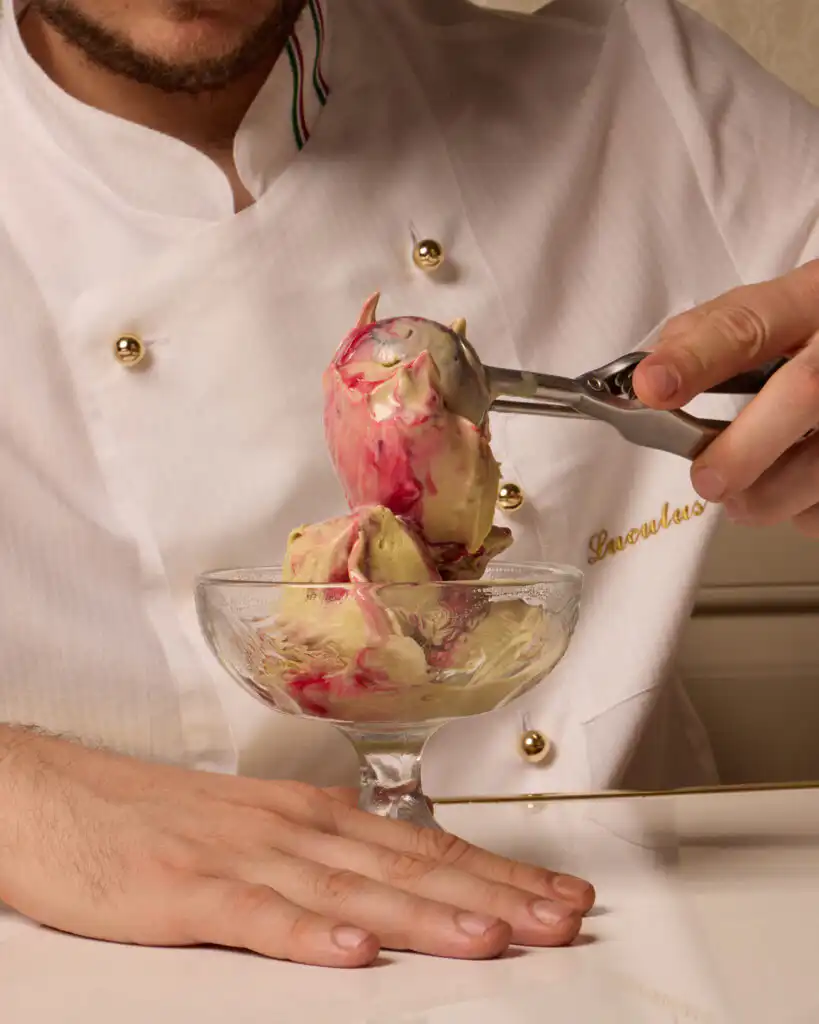
Tasting it for yourself
If you are in Bratislava, the short version of everything above is: order two small scoops rather than one large one, take a flavour you know alongside one you have never heard of, and eat it standing up before it warms past its best.
You will find us at four addresses in the city. Our current flavours change through the season, and if you want the background on where the recipes came from, our story starts in 1954.
Frequently asked questions
What is the difference between gelato and ice cream?
Gelato contains less fat and considerably less air than ice cream, and it is served about six degrees warmer. The result is denser, softer and more intensely flavoured.
Is gelato healthier than ice cream?
It usually contains less fat, but it still contains sugar and it is still a dessert. The more useful difference is that a well-made gelato is satisfying in a smaller portion.
Why is real pistachio gelato not bright green?
Because pistachios are not bright green. Ground pistachio in a milk base produces a dull, brownish green. Vivid colour indicates added colouring.
Can gelato be dairy-free?
Yes. Sorbet has never contained dairy, and plant-based gelato uses nut or coconut bases to reach a similar texture. Ask whether the cone is also dairy-free, as it often is not.
How long does gelato keep?
It is at its best within a day or two of churning. After that ice crystals begin to grow and the texture coarsens, which is why shops making it daily produce in small batches.
What should I order if I have never tried it?
Two small scoops rather than one large one, pairing something familiar with something you do not recognise. It is the fastest way to learn what a shop is actually good at.